
Our Orchards

Every Tree Tells Our Story

Initially, there was only CastelaS. Then, over time, we expanded the estate by acquiring new
plots. These plots, acquired over the years, allowed us to bring together old orchards previously fragmented by
inheritances, to recreate coherent and vibrant entities.
Each tree, rooted in the soil of the Alpilles, tells the story of this progressive construction of an estate designed to last, and
gives birth to olive oils true to their terroir.

Le CastelaS

Subtitle?

X Hectares – 19?? – Municipality
Our adventure in the Baux-de-Provence valley began with this magnificent 6-hectare orchard, all in one piece. Well-exposed on the southern slope of the Alpilles, in a place called Castelas, it is located in the municipality of Mouriès, very close to the village. Its origin is very ancient; it belonged to the same family for a long time, and writings from 1770 describe it as it is today. Contemplated by a succession of generations who cared for its trees, this orchard embodies the memory of their history. We are now its custodians. The Salonenque variety, emblematic of the Baux-de-Provence valley, dominates this olive grove, where Verdale and Grossane varieties are also found. These are trees that regrew after the 1956 frost, with an imposing and majestic appearance. The orchard has since expanded with land ceded by our charming neighbors.

Les Baumettes

Subtitle

X Hectares – 19?? – Municipality
This orchard, located near the hamlet of Les Baumettes (far from the Marseille prison of the same name!), aligns its trees on the southern slope of the Alpilles, not far from Mouriès. It is a magical, timeless place, composed of trees left wild for several years. We completely restructured it to restore vigor to the trees. In two years, they had regained their youth and reconnected with their role as producers. It is now a generous orchard in full production. It has expanded with a beautiful plot where we have transplanted main branches to restart with a single-trunk olive tree, which is easier to work with and prune. A magnificent twisted almond tree also stands there, as in other orchards, which used to delineate the plots—no fences or barbed wire here!!

Romanin

Subtitle?

X Hectares – 19?? – Municipality

This 14-hectare plot, planted in the municipality of St Rémy de Provence, very close to the old Romanin chapel, is surrounded by garrigue and holm oaks.

It brings together the three typical olive varieties of the Baux de Provence AOP (Aglandau, Salonenque, and Grossane) and is located on the northern slope of the Alpilles. We have watched the trees planted in 1998 grow.

They produce quite regularly and are easy to maintain because they are single-stemmed. It is a very beautiful orchard with the steep northern slope of the Alpilles to the south and a view of Mont Ventoux to the north.

Les Baux

Subtitle?

X Hectares – 19?? – Municipality
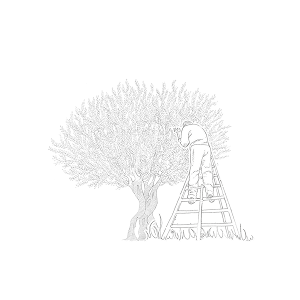
Located just above the mill, this orchard with its old shed is a magical place where it is pleasant to walk among the imposing trees, mainly of the Grossane variety. It’s a place where we love to meet and chat with our friend Rémi, who has the privilege of maintaining it. Assisted by Chantal, he pampers and cares for it all year round, delighting in picking Grossane olives, both green and black, for the table. If you see him on his easel, he will tell you himself!

Les Aulnes

Subtitle?

X Hectares – 19?? – Municipality
Ten years after settling in Les Baux, with ten years of experience behind us and a clearer vision of the olive oil market, we decided to plant. This planting addresses a very simple and recurring need: to compensate for the lack of olive production that we hoped to control with pruning and irrigation. Our old varieties are too capricious. Our friends at Jean-Martin company having the same problem as us, the supply of French table olives for their culinary preparations, we decided to partner. This is how the Les Aulnes orchard (named after its pond) was born in Saint Martin de Crau. This project was and remains a challenge. We had to venture onto unknown and uncultivated land. Anyone who has not seen the ‘coussouls’ of the Crau cannot imagine it: very stony, arid terrain, red earth, a desolate landscape, yet teeming with flora and fauna in perpetual struggle with natural elements such as grazing herds, summer drought, and the mistral. Another difficulty was the existence of a true natural cement slab or ‘puddingstone’ ten centimeters below the soil surface. Few trees survive in the Crau. The olive tree is one of them, as the entire property is dotted with wild olive trees. We were certainly unaware at the time we embarked on this adventure. Neighbors are always distant in the Crau but offered good advice, especially regarding the equipment to use. It is well known that a lot breaks in the Crau. The planting was done in several phases, resulting in 65 hectares with typical local olive varieties, but also some ‘foreigners’ in the plot called ‘the garden’. Our first ‘real’ harvest took place in 2013. We produced beautiful table olives (Salonenque, Béruguette, black Grossane varieties) and extracted a very powerful olive oil.
La newsletter Castelas